
THURSDAY, NOVEMBER 27, 2025


Belfast Playwrights: 10-Minute Plays
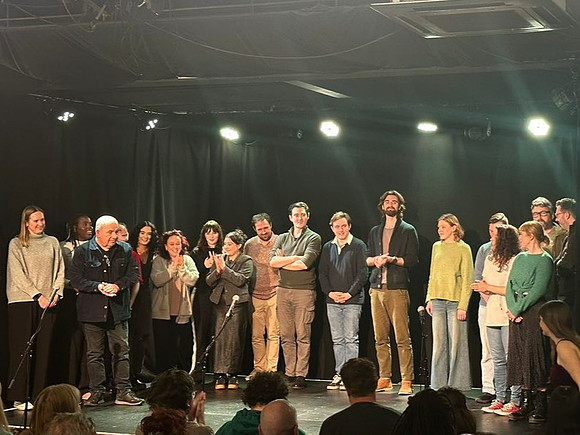 The participants of '10-Minute Plays' on stage at Belfast's Black Box.
Photo courtesy of Heather Martin
Earlier this year, I attended a festival of ten-minute plays at Belfast's Black Box hosted by Heather Martin's Belfast Playwrights, a fresh, lively and vital showcase for emerging theatrical talent in Northern Ireland. The promise in the works I saw that night was rich, so much so that a return to the same venue for a similar festival later in the year appeared welcome as well as inevitable.
So I find myself at the Black Box again, ready for another collection of developing works that on this occasion seem to be linked by their depictions of various reunions. Reunion, then, is a significant and fitting word for this evening in more ways than one – the intriguing connection between these plays, and the much appreciated and heartwarming reconnection with Martin and her team.
The night opens with Darcey Youngman's As We Were, starring Clare Duffy and Bernadette McKeating as a duo who haven't seen each other for years. As the characters chat at a table, comments on changing palates, indications of status symbols and musing over professions hint at a contrast between self-control and environmental shaping that would impact anyone's personality over a long period of time, let alone these two. But as the conversation develops, the intensity rises, with both Youngman and the actresses drawing on enduringly thoughtful issues. Is there more freedom from venturing on a whim or the calmness in a settled life? How does one cope when their way of living, or what might be a near lifelong impression of someone, could be destabilised by the shockingly revelatory? In reminiscing over who they were, the characters are developing who they are, and it's a strong introduction for the evening ahead.
No face from the past greets Shami Madondo's Eileen in Syd Trotter's one-person play Still Here Like, directed by Scott Marshall, but rather the faceless, one person's descriptive recollections of a systematic hierarchy where she has struggled to find the help she needs. Madondo is quite phenomenal in a passionately wrenching soliloquy where the startling and saddening intricacies of Eileen's form filling experience are revealed - a situation where she seems to be judged for what she can manage, or can still do, ahead of who she is. The value of an identity that is never fully allowed to shine through the pigeonholing of paperwork is the poignant heartbeat of the work and Madondo's acting, and the applause that follows is richly deserved.
A deceptively relaxed and introspective but truthfully dynamic work, RP Brown's Danny Burns, starring Andrew McNeill and Carla Bryson, is about masks in every sense - those one wears in the sense of concealing identity and protecting health but also as dramatis personae, what we be to hold back who we are and how revelations in the former bring out the latter. Another "face from the past" reunion of a kind, it's a marvellous exhibition for the very impressive McNeill and Bryson, their sometimes reserved and sometimes open showings of passion fully capturing the audience's attention.
Monetary class and social tact are prominent in Sam Press's I Can't Stay, starring Press and Jack Elmore as two men united by professional aspirations, divided by tragedy but then reunited by concise yet crucial conversation. The skill in Press's writing, and in his and Elmore's performing, is in showing how the observation of comfort and convenience, and the very opposite of those, impacts advice and viewpoints that can be helpful to one but detrimental to another. It's also about the divisiveness in pride and envy, and the severity of the complications in intimate, insular catastrophes – indicating another tragedy, that some bonds may well be irreparable.
In amplifying careerism and humanism while bringing a mother and daughter together, Jonathan McCully's Resignation, directed by Tabitha Minson and featuring Chloe Campbell and Maria Quinn, smartly demands that its central character mull over the realities of life mechanics. Imagine if one has been rewarded for what they could, or did, do without stopping to consider if it should be done - and therefore, the resignation of the title is likely in the acceptance of truths that were swept under the proverbial rug for too long. It's an explorative effort that, in a short time, takes a gentle but telling dig at the facets of living that may fuel one person's bold ambitions and another's serious setbacks. Its appeal is magnetic.
Anyone who is struggling to look after a devastatingly declining relative may relate to Megan Armitage's Amy, and Armitage's heartfelt performance, in Kristen Kernaghan's High Low. But, more than the shattering effects of dementia and its effect on everyone close by, Kernaghan's work, also starring Andrew Dickson, John Moriarty and Neve Ellen Wilkinson, commendably challenges the fictional depictions of the caregiving female and the stunted male, the polarised highs and lows in responsibility and irresponsibility ceasing to be when faced with sudden and shocking developments. It reads as an examination of the initiative in traditional gender roles and what happens when said examination needs facing – like its theatrical siblings on the night, it's a reunion of sorts, but maybe the most unexpected of all. The potential in every piece of work here is simply tremendous.
Simon Fallaha
Belfast Playwrights staged a 10-Minute Play Festival at the Black Box, Belfast on Monday November 24 and will stage an Irish 10-Minute Play Festival at Cultúrlann McAdam Ó Fiaich on Wednesday December 3. Click here to visit their official website.