
SATURDAY, AUGUST 16, 2025


Julie
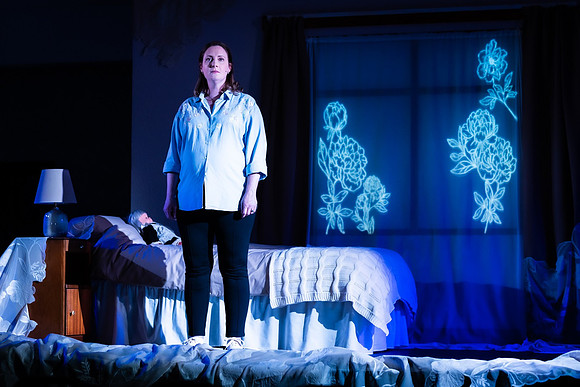 Charlotte McCurry in 'Julie'. Production Photo: Ciaran Bagnall
Charlotte McCurry's Julie, directed by Paula McFetridge and performed by McCurry for Kabosh Theatre Company, is poignantly illustrated family history as stupendously crafted art. A one-woman, seventy minute delve into the memories of McCurry's aunt Julie Livingstone, the production strikes just the right balance between levity and devastation in impressively, and at times wrenchingly, detailing a fresh, close-to-the-bone perspective on the Troubles.
The play's perspective is primarily through the eyes of Julie's sister Bernadette, whose recollections of her time with Julie in early 1980s Belfast, mainly spoken by McCurry herself, are the heart of the narrative. The presence of a doll on the bed of Tracey Lindsay's bedroom set says so much – it is like this is one of a handful of things that the family know they have to remember Julie by. For Julie, before McCurry was even born, was shot on the way home from a shop in West Belfast in 1981 and ultimately killed – therefore this is an instance where memories, keepsakes, grief and second-hand experiences stand out. And all of these are drawn and expressed so lucidly and so vividly that one really does feel as enveloped in the reminiscence as McCurry, visibly aching with an astonishing range of emotion throughout, does.
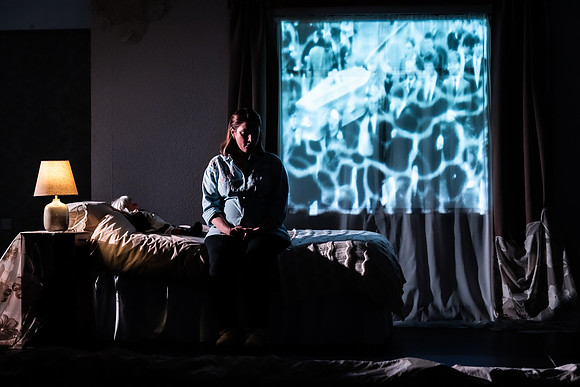
Charlotte McCurry in 'Julie'. Production Photo: Ciaran Bagnall
In telling this story, her story, McCurry brings much attention to the wonder that arises from experiencing what genuinely seem like strange new worlds to childlike eyes and the pain that is brought from being confronted by premature loss of life. Starkly but beautifully contrasting the rocks and the bricks out on the troubled streets of Belfast with films watched, books read and places visited for the first time raises the truth of continuous adaptation for the soul, which no one at any age can be truly prepared for. It is, quite possibly, about protection as resilience or shelter, the resilience which can come from facing the elements and events that people have no choice but to face, the protective shelter that may develop from envelopment in a land of corner shops, clothes and music, and what happens when the insularity of one's personal world meets the veracity of the outside world. As it tragically must.
What is shown in Julie is as vital as what is told, and in Lindsay's set and costumes, Ronan McManus's lighting, Fergus Wachala-Kelly's visuals and Katie Richardson's sound design, we find the kind of creative accompaniment which helps Julie soar, an aesthetically and melodically captivating illustration of discovery and vulnerability. In a sense, it comes down to a moment where the musical records in Julie's family are being mentioned, where it might dawn on us that these particular records, in our music collection, may someday be broken, but the historical records of our families never will be. For, like a piece of music, family history may continue to endure through the pathway from imagination to reflection and the trauma and transition that can emerge within. The audience come away from Julie with a reminder that a retreat to repeat, to recall, can sometimes be one of the strongest forms of evolution - especially if the recollections are as powerful as these.
Simon Fallaha
Julie continues running at Derry-Londonderry's Playhouse Theatre until Saturday August 16 before the final, sold out performance of the current run at The Old Church, Cushendun, on Sunday August 17. For more information on the play, click here. For tickets for the second Playhouse performance, click here.