
SATURDAY, JUNE 6, 2026


The Effect
Production Photo: Polka Dot Photo
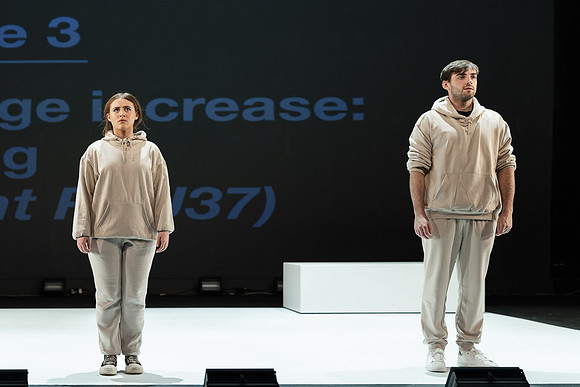
Lucy Prebble's The Effect, directed by James Murphy for Bardic Theatre, is a genuinely unique, observant and honest case of the line between the inquisitive and the intrusive expanded upon and told as a thoroughly intriguing and affectingly personal story. It is a narrative where systematic and social truths are deftly unveiled in an intentionally sterile environment, a play where four committed performers frequently entrance, sometimes enthral and often stun the audience by opening a sharp, sincere and entirely heartfelt window into a uneasy but spellbinding world.
And there is indeed a spell to be bound on a growing bond between Connie, played by Anna McCloskey, and Tristan, played by Kevin Canavan. As test subjects for continuously increasing dosage of a new anti-depressant, Connie and Tristan find human desire unavoidably burgeoning from an inhumane procedure where "feeling" and "being" gradually become impossible to tell apart. Especially when they are trapped in an area and wearing clothes distinctive only for their lack of colour, presenting a situation where the colour must arise from inner personality rather than outer surroundings. The general blankness of the set, which seems like the complete antithesis of designer Stuart Marshall's usually vibrant and detailed work, is perfect here, contributing to the increasingly arresting and temperamental volatility that primarily drives Connie and Tristan both individually and as a pair.
The dependence on a "pill for every ill" and societal implements is challenged, replaced even, by a dependence on another soul, and from this scenario, Prebble's script draws a multitude of astounding revelations. One is indicated by Connie's need for her phone – the treasuring of personal privacy contradicted by the pride in a very public life online, the desires fed by the small screen leaving one much less prepared for the face-to-face connections that can truly heal. And healing is right at The Effect's core – we find that the scientific, the psychological and the medicinal are processes for healing rather than the answer by themselves.
Production Photo: Polka Dot Photo
It's about chemistry, really. The procedural and the organic, and the difficulty in separating the two. And the increasingly complex chemistry between the marvellous McCloskey and Canavan is a delight to watch, with each visibly relishing in how they depict the situational craziness. There is more than one way to "love", be it the idealised escape, the physical rush and the calmly tranquil, and much is learned from watching Connie and Tristan explore all this. Even their names are appropriately symbolic – Connie, the constant connection and convenience in another person's life, and Tristan, he who evokes memories of Isolde and another "love potion".
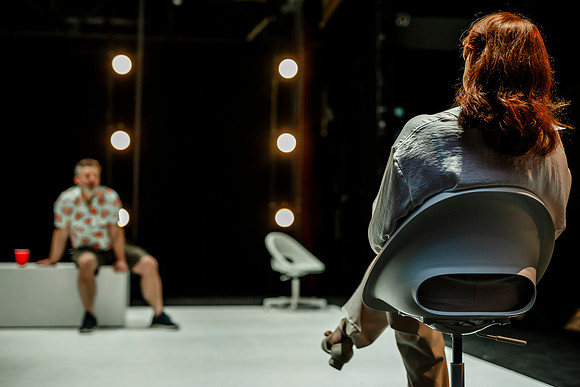
Murphy's excellent direction also sidesteps the danger of imbalance that could arise from the prominent focus on Connie and Tristan's tale, with Máire Coyle and Declan McGrath also giving excellent performances as psychiatrists Lorna and Toby. Through them we see the adult fear of helpless and irrelevance in the face of more youthful actions and reactions, which, in Toby, parlays itself into the image of a showman, the public self-help specialist whose wisdom can be thought of as either crucial or condescending. And Coyle has a rather beautiful moment where Lorna confesses her own troubles to Connie – the dependent becomes the dependable, the helped becomes the helper, and the overall effect of The Effect is subtly strengthened. What I think we have here is a lengthy cry for help repackaged as the realities of compressed head or heart space, which stands to endure not only for its themes, but its energy and eloquence, and the pride its actors clearly take in conveying all of that to us.
Simon Fallaha
Bardic Theatre's production of The Effect concludes its run at Belfast's Lyric Theatre on Saturday June 6. For more information on, and tickets for, the Lyric Theatre run, click here. For more on the play itself, click here.