
WEDNESDAY, FEBRUARY 18, 2026


The Human Voice
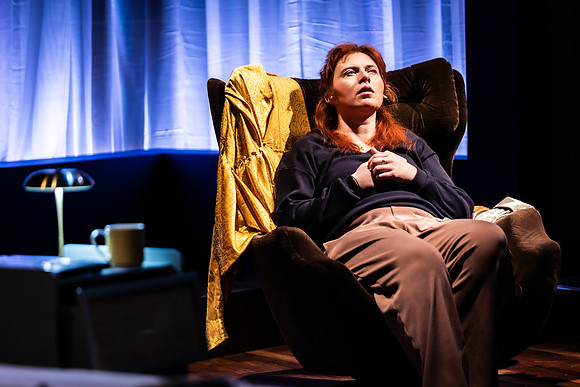 Nicky Harley in Darren Murphy's adaptation of 'The Human Voice'.
Production Photo: Ciaran Bagnall
Darren Murphy's adaptation of The Human Voice is a classic Cocteau cocktail, a mesmerising mixture of powerfully personified emotion made entirely real by the commanding presence of Nicky Harley at Belfast's Lyric Theatre. Directed by Emma Jordan for Prime Cut Productions with a level of taut and arresting professionalism that we have come to expect from both Jordan and the company itself, the play and Harley's performance are the kind of play and performance that don't simply engross and entertain but enlighten, edify, intrigue and even intimidate. It is a clinically concise one-woman show that traditionally reveres and locally revolutionises its source material as an act of relatable reaching into a sorrowful but sturdy soul for pointed profundity and earnest expression.
Earnest, yes. So you'd be tempted to say that The Human Voice is about the importance of being earnest, very like the Wilde ride of the same name taking place on the main stage right next door to the Lyric's Naughton Studio, where we sit and Harley acts. And that it certainly is, with Harley dedicatedly conveying fervency, fierceness, solemnity, sincerity, intelligence, intensity and all sorts of alliterative adjectives that you could certainly associate with Oscar Wilde. But they are fitting for Jean Cocteau too, with the titular human voice he concocted almost a century ago finding another novel way to entrench itself, this time in a Belfast setting.
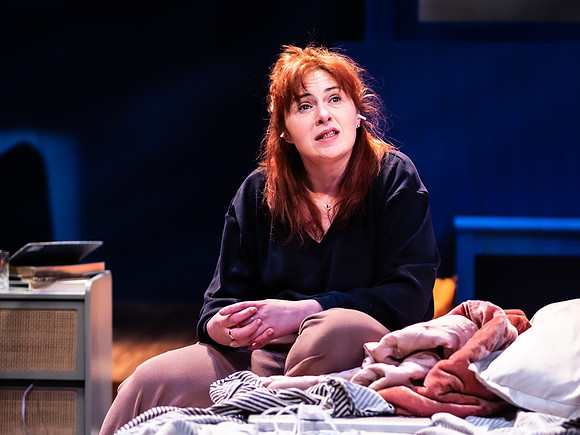
Nicky Harley in Darren Murphy's adaptation of 'The Human Voice'.
Production Photo: Ciaran Bagnall
Driving Cocteau's play, and now Murphy's, are the loneliness, resentment and betrayal felt by a woman facing the end of a relationship. Here, though, the stakes feel doubled, even trebled, with Harley's mental health telephone operator relaying her feelings from the centre of the studio to audiences on three of its sides by way of talking to both a distressed caller and her soon-to-be lost lover on the phone. For the most part, we don't hear their human voices, but we always hear and see Harley, and the trio of seating areas in the venue rewards multiple viewings with differing perspectives. It's demanding, ingenious and rigorous. And the stakes are further multiplied by the visual detail in yet another instance of impeccable Ciaran Bagnall design, which features a succession of vinyl records on the floor, an unmade bed, a mirror, a chair in the corner and a clever use of the studio's window which opens our eyes to the then dark dampness of both Ridgeway Street and the struggles Harley conveys. The emotive weight is amplified by Rosie McClelland's skilled costuming and Conor Mitchell's astute sound and compositions.
Music, be it popular or incidental, is one of several crucial complements to Harley's character. In the play's use of once nostalgic and now repopularised vinyl records, we may find the strong narrative thread of looking back to look forward, from which knowledge and resilience are built. This Human Voice is, one could argue, Groundhog Day as an isolated state of mind, accompanied only by repetitive voices and repetitive music. How appropriate is it that Harley's woman cites Shirley Bassey's "Never, Never, Never", a repetitive title, and is later seen to enjoy Sonny & Cher's "The Beat Goes On", a song with an iconic, repetitive refrain? Just like their "I Got You Babe", which symbolised the journey of Bill Murray's Phil Connors, these songs, and the play, seem like genuine exercises in returning to learn.
The manner in which Murphy integrates these references, among others, ensures that this Human Voice stands out as a stupendous illustration of how interest in pop culture seems to write, let alone accompany, life experiences. But it's more than that. Murphy's language, spoken so vividly by Harley, is also an unsettlingly wrenching and twisted window to dependency, desperation and aspects of city life that aren't so kind. It is clear in its understanding of how individual needs differ from societal mechanics when the former are centralised at the expense of, and through reliance on, the latter. How self-focus can taint points-of-view as well as strengthen them. How repeated actions can be a route to numbness as well as wisdom. It is a human voice, for sure, but it is also life at its most personal, immediate and certain – the kind which we wholly benefit from experiencing as an audience to this impeccable piece of theatre.
Simon Fallaha
The Human Voice runs in the Naughton Studio at the Lyric Theatre, Belfast, until Saturday February 28. For more information, and tickets, click here.