
SUNDAY, MARCH 8, 2026


BCF 26: The Little Prince
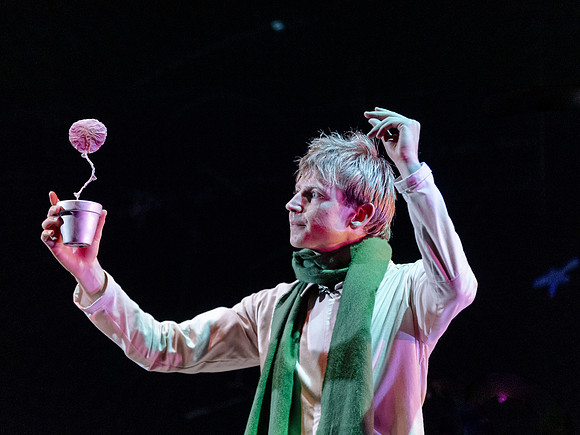 Toby Thompson in 'The Little Prince'. Photo courtesy of Young at Art
When I first heard of Toby Thompson's adaptation of The Little Prince, I couldn't help but think of a story I've known well since my own childhood, the similarly sounding and, as it turns out, similarly themed The Happy Prince, by Oscar Wilde. With The Little Prince's story instigated by a pilot crashing in a desert and blossoming while said pilot finds unexpected ways to stay alive, memories also go back to Roald Dahl and his own crash in the Libyan desert, famously documented in Going Solo. I wasn’t aware that the direct inspiration was a book penned by French writer and aviator Antoine de Saint-Exupéry, nor that said book was a favourite of Hollywood icon James Dean. But as the saying goes, you learn something every day, and that's what makes this Little Prince what it is – learning something in many ways.
To these eyes, it's more than a story of learning - it is also a story of resilience. Personal growth and survival on a tremendously imaginative scale, where childlike creativity not only contrasts with but genuinely seeks to counter adult routine. However close it may be to its source, the show is definitely both Wildean and Dahlian – here one sees the importance of being earnest to the self while also recognising, as Dahl wrote, that "children are not so serious as grown-ups".
The Little Prince also shares, however faintly and indirectly, a theme with The Happy Prince – a form of gradual absorption, rather than surrender or sacrifice, to society and nature, where previously defined individual ways of living gradually ebb way for a form of common good. In this case, it's wisdom, which grows when the pilot of the story, stranded in the Sahara following his crash, tells of meets the titular "little prince", who in turn tells the pilot of his voyage to all sorts of asteroids and his meetings with all kinds of people.
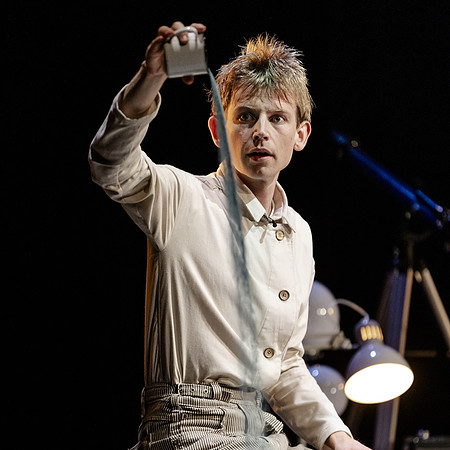 Toby Thompson in 'The Little Prince'. Photo courtesy of Young at Art
One journey – the pilot's – may have come to an abrupt halt, but another one has begun, and Thompson's engaging expressions and astonishing vocal fluctuations bring every one of The Little Prince's characters fully alive. Among them are a king and a businessman, both made distinctive and rather hilarious by their perceived peculiarities, and an appropriately clever fox. Thompson is well assisted by the arresting and ambient set design, which features orbs on a stand that colourfully light up to indicate the mood and relevance of the asteroids in a story, a cluttered desk from which many an artist gives rise to their creative impulses, and stars beautifully projected on a backdrop.
Returning to Dahl, Wilde and the sources that Thompson may have drawn from to inspire himself, I think The Little Prince speaks, more than anything, to how much one's personality is shaped by the many stories they grew up reading and how one can reflect on them to broaden understanding and discovery. Even if this little prince might not be real, he carries real meaning for the pilot and for us – as with Margery Williams' The Velveteen Rabbit, memorably adapted at last years Belfast Children's Festival #BCF25, there is the sense of one being giving life to another, and vice versa, with evolution each way. When Thompson says that "the most important things are invisible" and that "only the heart can see clearly", one feels and believes that The Little Prince has done everyone in the audience a big service in terms of initiation of imagination – it's excellent for the young at heart and the young in art.
Simon Fallaha
The Little Prince runs at Belfast's MAC as part of the Young at Art Belfast Children's Festival 2026 (#BCF26) until Sunday March 8. For more information, and tickets, click here.