
THURSDAY, OCTOBER 22, 2026


BIAF 26: Faith Healer
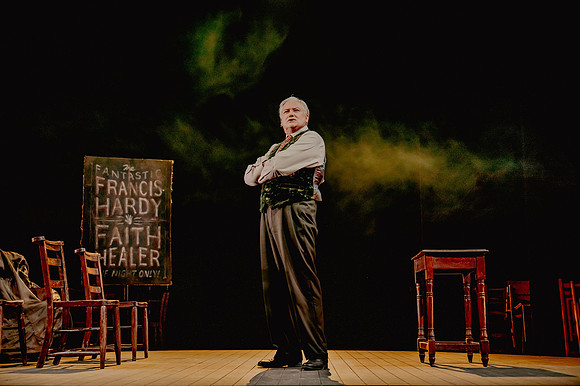
Conleth Hill as Francis 'Frank' Hardy in 'Faith Healer'. Photo: Carrie Davenport
The restorative qualities of the Lyric Theatre's production of Brian Friel's Faith Healer, directed by Emma Jordan, feel beyond beautiful in their intricacy and almost unparalleled in their honesty. I'm deeply moved both by the play and by the choice of the play as an opener for this year's Belfast International Arts Festival #BIAF26, while recognising that it may not be for everyone – the rawness of the vulnerability exhibited in the indisputably superb performances from Conleth Hill, Lisa Dwyer Hogg and Chris McCurry may almost be too much to bear. But for those who can, will and do, the rewards - thematically, narratively and emotionally - will be enormous.
The main stage at the Belfast theatre, celebrating its seventy-fifth anniversary this year, is set up to explore the purpose, professionalism, promise, pain, pleasure and propensity - at least! - for the magic, mystery, support and structure embedded in faith-healing. Yes, magic, for anyone who has read about faith-healing at any time will get the idea that its enduring power stems from the belief that anyone, anywhere or anything associated with the concept can simply make problems go away. It is never really that simple but the desire to believe that it can be is, arguably, what keeps us going – and what can also eat away at our souls, leaving us either hugely fragmented or a hollow shell of what we can be, used to be or maybe wished to be.
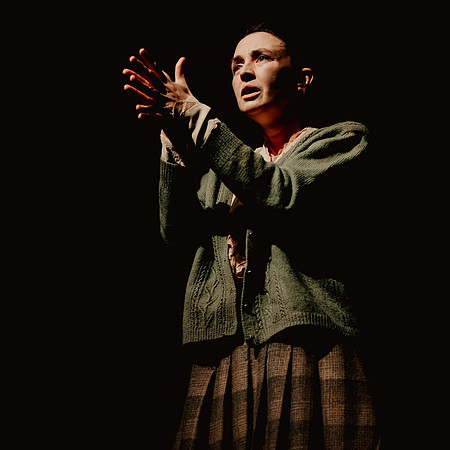
Lisa Dwyer Hogg as Grace in 'Faith Healer'. Photo: Carrie Davenport
Therefore it is most appropriate that hollowness, or fragmentation, are expertly represented by another excellent Stuart Marshall set, which uses a sign advertising titular Faith Healer Francis, or Frank, Hardy to paint the impression of hope in broad strokes while leaving spaces between the chairs on the floor and gaps in an unstable ceiling comprised mainly of wooden planks – it's psychology, psychiatry and the perception of pseudoscience associated with forms of faith-healing like dowsing right in front of us. It's not the only arresting aspect of the aesthetic either – Enda Kenny's superb costumes for Frank (Hill), his wife or mistress Grace (Dwyer Hogg) and his manager Teddy (McCurry) are fascinating reflections of their personalities.
Each character, firstly Frank, then Grace and finally Teddy, with a coda for Frank, takes their turn to perform what I will call their "personal perception of their position" to us. Yes, it's monologue theatre, a genre where the individual concentration can create a communal distance. But Jordan's direction of soloists, which has already provided an astonishingly human voice for Nicky Harley this year in Darren Murphy's The Human Voice, is smartly aligned to a play where the solo monologues find a way to interconnect smoothly and emphatically. You're in no danger of losing focus on, or being taken out of, this world.
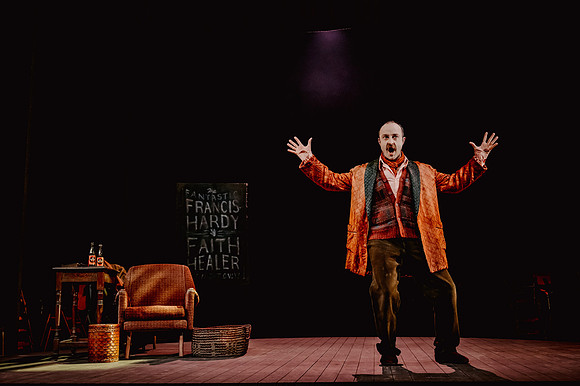
Chris McCurry as Teddy in 'Faith Healer'. Photo: Carrie Davenport
One of the many thematic strands I have paused to consider since seeing the play a week ago is the idea of the faith-healer as a dreamlike saviour to some and a nightmarish charlatan to others, and how that feeds into the conflict of not only a customer but the healer himself. By choosing to focus first on the healer, then the wife or mistress, then the manager, Friel's play, originally staged in 1979, presents itself as a patient and tantalising emotive and structural exploration of lasting truths – a salesperson, their partner and their controller gradually building an increasingly detailed portrait for our consumption. And with each set of recollections, we are as enticed by their delivery as we are intrigued by both their reliability and, perhaps, our dependence upon what we hear and see, which is relevant in light of how each monologue might connect to our own ideologies. For faith does not necessarily need to be healed by a "faith healer", per se – Grace's personal faith is also tested by Frank's role as a partner, and Teddy's managerial journey is defined by what Frank and Grace do for him. You could say he’s the "teddy bear" for the others, their source of comfort and reassurance, while Frank looks for grace from the lady, and we see a form of blunt clarity in the healer himself. To be frank, indeed! No, the names do not appear subtle at all, and it's actually enormously beneficial to the work – each character looks like they have been driven to spell out their concerns with distinctive force, and we are as unsettled as we are compelled.
The trio of Frank, Grace and Teddy win our love not necessarily because we identify with them but because we recognise them – their individual stories and communal connections are everything that the play promises to be, differing and similar tales of hopeful projection towards a uneasy environment where the exposure of understanding damages a narrative of representation but crucially expands and cements a narrative of truth. So Faith Healer, in this form and on this stage at least, isn't just an exhibition of faith, but a test of it, a pressurised battle of identity which shows people at their most open as both a document and a guide. It isn't merely about a faith healer, it is a faith healer - the planting of faith in a world of spiritual healing.
Simon Fallaha
Faith Healer runs at the Lyric Theatre, Belfast, as part of the Belfast International Arts Festival 2026 #BIAF26 until Saturday November 14. For more information, and tickets, click here.