
TUESDAY, MARCH 24, 2026


I, She, Medusa
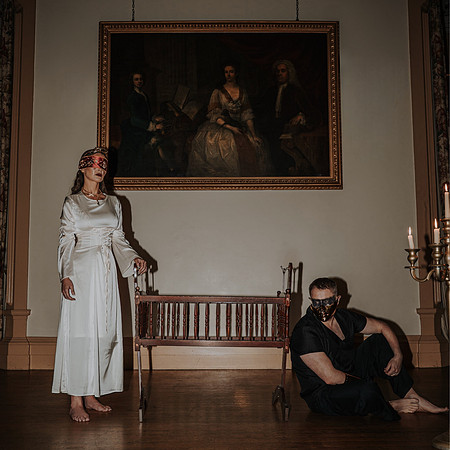 Photo courtesy of Dark Forest Theatre
I, She, Medusa, a Dark Forest Theatre production written by and starring Nathan Martin and also starring Jade O'Neill, is an intriguingly dark narrative which blossoms and burgeons like a most prominent tree in a most fertile forest. It is fact and fairy tale blended for mysterious murk and the searching of the soul, a short but compelling doorway into a universe as familiar and relatable as it is distinctive and fresh.
While successfully crafted as a story of remembrance, as a tribute to "all the women who have been taken from us", I would suggest that I, She, Medusa goes beyond its primary message to also find a more universal appeal. It has a raw, fractured and experimentally intelligent nature which speaks of the complications in anyone who would try to figure out both their world and the world, a heavy burden for anyone to take on, let along the Medusa of the title.
That is, of course, I, She and Medusa, two pronouns and at least three means of identity given human form by O'Neill in a thorny, twisted and frankly terrific portrayal that beautifully complements and builds on the promise shown in director Michael Quinn's recent revival of Baby It's Cold Outside. Beginning the show by playing pretend like a Disney princess, be she a determined Belle from Beauty and the Beast or a wide-eyed Giselle from Enchanted, the only company O'Neill's character has is Martin's character, who adapts the persona of the God Hermes and pretty much humours what she does. But the art is not merely a source of amusement for O'Neill here. It's a form of survival, an implication that pretending to be who she isn't is her only way of fitting in and communicating with the world while a giant projected clock forebodingly ticks away in the background.
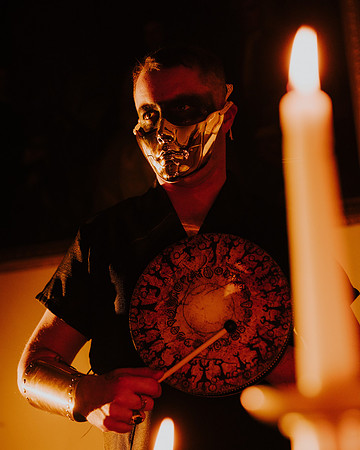
Photo courtesy of Dark Forest Theatre
As with Martin's excellent Marjorie's Dead, any literary, cinematic and theatrical comparisons, allusions and references are impressively incorporated, and I, She, Medusa is filled with them. It is hard not to be reminded of Joachim Trier's astounding Sentimental Value, another story of how the sentiment in and the value of art and life are contrasted to the point where one is in danger of not being able to separate the fictional, the familial and the factual. What's actually required, and I, She, Medusa gets this too, is realistic contrast and empathetic sharing, while recognising that the time and place for this Medusa and her Hermes might not be able to permit this.
The time, and the place, in this scenario, is that large ticking clock, a form of knowledge and a way of life at once. It is the sort of thing that instils fear as days, months and years go by, hinting that we ultimately reach a point where more is being taken away from us than being given to us. The curiosity of a working timepiece becomes a source of knowledge, then a convenience, and eventually frightening – is there room for further literary citations in I, She, Medusa? I believe there is. The increasing wisdom we and O'Neill's characters receive and how we cope with that brings to mind the Garden Of Eden, while O'Neill's depiction of imagination and storytelling as a means of staying alive in the face of a dominant, fearful figure echoes Scheherazade and her own life on the edge during the one thousand and one nights. Yet I am thinking, on the whole, along the lines of a seemingly more despairing but equally hopeful Shirley Valentine viewed through a mythical and legendary lens, where the figure at the heart of the story looks within herself and around her on a quest to find the girl she used to be. And we hope she succeeds.
Simon Fallaha
A Dark Forest Theatre Production, I, She, Medusa recently enjoyed a short run in the upstairs theatre of Belfast's MAC from Thursday February 26 to Friday February 27. You can find more information on the play here.