
FRIDAY, JULY 3, 2026


Steel Magnolias
Production Photo: Carrie Davenport
Robert Harling's Steel Magnolias is a play I've sadly never had the pleasure of being properly acquainted with until recently. Before arriving at Belfast's Lyric Theatre for director Emily Foran's sumptuously staged and superbly acted production, I hadn't even seen the film. I had been that in the dark. Really, the overall strength of both the play and its source shouldn't have been that much of a surprise, because I genuinely love Foran's work. The effects of her take on After The End from nearly a decade ago are still lingering to this day, and her Little Women, due to return to the Lyric this Christmas, is a masterpiece. Her trust in actors either as a physical force or an emotional unit appears unparalleled, and her eye for visual detail is inspiringly elevating. Steel Magnolias is another one of those occasions where every one of Foran's strengths connect eloquently with the material and bring brand new life to classic tragicomedy, giving us a truly exceptional piece.
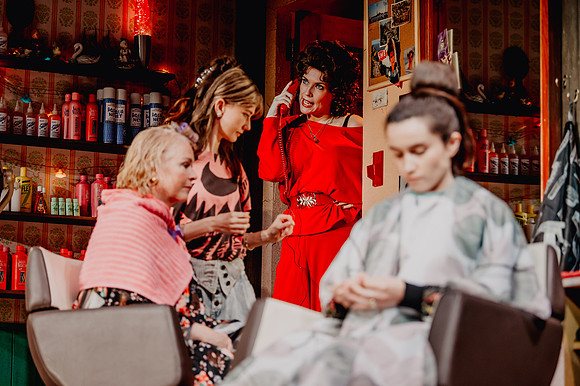
What's likely held me back a little in writing my own piece on the piece – and perhaps giving my head peace – is the question of how one possibly write about Steel Magnolias without talking about the plot's devastating blow, the spoiler that's known to define the play. Well, you can focus on the word "talking" from my question and attach it to the six women we meet – confident beauty salon owner Truvy (Orla Mullan), her shy apprentice Annelle (Eímhear Jackson), the socialite Clairee (Marion O'Dwyer), the grumpy Ouiser (Carol Moore), the vulnerable Shelby (Simone Collins) and Shelby's mother, M'Lynn (Janet Moran). Brashly archetypal from an initial viewpoint and very colourfully illustrated in yet another set of wonderful Catherine Kodicek costumes, these women talk – lots – and in doing so, gradually strip away the brashness and the archetypical while wrapping us under an evocative, provocative and poignant spell. It's the ultimate riposte to the derogatory and patronising tone in the voice of Ross Geller when he tells Chandler Bing, in Friends, that women talk, or if you prefer, the loathsome condescension in Sir Humphrey Appleby's "dear lady" remark to Yes, Prime Minister's Dorothy Wainwright.
Yet if Steel Magnolias was merely a form of "biting back", it wouldn't be the powerful play that it is. It goes beyond gender appeal partly because of the multi-dimensional functionality of Truvy's salon, which exists as a therapeutic sanctuary and a pressurised enclosure for truths and feelings to bubble to the surface. Ronán Duffy's very richly detailed set draws the salon in enticingly lavish colours which appropriately echo the deceptive but dazzling allure of 1980s America, a form of escapism for communal Westerners then and now. Of note are a pair of fans on the ceiling, one of which spins faster and is at a lower height than the other – is this indicative of the vibrant desire which slowly fades to the more stabilised wisdom of our ageing years? Wisdom which can troublingly be taken for granted when the young look to their elders for help and support?
Production Photo: Carrie Davenport
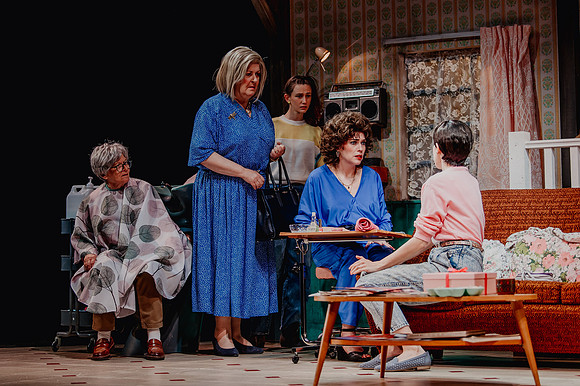
It may well be. And if you look closely you can see the effect of mentoring, being an imposing presence or feeling maternal on Truvy, Clairee, M'Lynn and Ouiser. Such is the subtle weariness which Orla Mullan, Marion O'Dwyer, Janet Moran and Carol Moore bring to these most fascinating, most recognisable and most pitiable characters. I especially enjoy how Mullan's Truvy battles to balance stress with success, possibly taking more joy and command in the latter because of a lack of control over her personal life, a mood which translates both to Eímhear Jackson's Annelle, who simply lights up the stage with her earnestness, and to the heart of the whole play, Simone Collins' Shelby. Shelby is, in a way, Audrey Hepburn, a woman who, whether she wears a "rebellious" pixie cut like Roman Holiday's Princess Ann or the classically elegant updo of My Fair Lady's Eliza Doolittle, projects an image of unstoppable strength or unattainable beauty, yet her personal life is overshadowed by health problems, insecurity and unhappy unions. It's the performative versus the truthful, who we're expected to be versus who we actually are. A vital theme for everyone to take on board. And by conveying this as a form of conversational loyalty to each other, these actresses, with the help of Keith Singleton's voice as the Radio DJ we hear in the salon, make a very strong case for being the best theatrical ensemble of the year.
Steel Magnolias joins a succession of similar standout works from 2026 such as Consumed, A Bomber's Moon, Cuckoo-Land, Girls And Boys, Tea In A China Cup, Bold Girls and The Human Voice as a much needed, much appreciated and most welcome exhibition of female and human voices on the stage. In the hands of Foran and assistant director Debra Hill, Harling's play simply bursts with heart and soul and provides many opportunities for the thoughtful, the jocular and the moving. You could say that our director, Emily, has definitely brought Steel to these blossoming Magnolias, and the result is dynamite theatre, explosively entertaining. Proof that laughter through tears is, indeed, an emotion to be valued. Yes, Dolly Parton's character was - and now Orla Mullan's character is - right.
Simon Fallaha
Steel Magnolias runs on the Main Stage at Belfast's Lyric Theatre until Friday July 10. For more information, and tickets, click here.